










"Knowledge is the path that leads a person to greatness" - Alisher Navoiy

English Language Theory and Practice Department

English Language Theory and Practice Department

CONTACT WITH US
CONTACT WITH US

Established in 2023 at Chirchiq State Pedagogical University, the Department of English Language Theory and Practice focuses on developing communication skills and professional competencies in English for various academic and professional fields.

English Language Theory and Practice" Department

Year of Establishment and History of Development The "English Language Theory and Practice" Department was established based on Decision No. 1 of the Chirchiq State Pedagogical University Council in August 2023, and the subsequent Order No. 01-242 of the University Rector dated October 27, 2023, "On Amending the University's Organizational Structure," which formed it on the basis of the "English Language" Department within the Faculty of Tourism. The department is located at Chirchiq State Pedagogical University, Main Buildin, Room 309, Tashkent region.

Mission and Objectives of the Department Mission:

To develop the communication skills and professional competencies of professors, teachers, and students of foreign language and literature (English language) in non-philological and specialized fields, utilizing innovative methods of English language teaching.

Objectives:

  • Teaching subjects related to the methodology of teaching English language and literature.
  • Developing curricula and materials.
  • Organizing practical training and professional development courses.
  • Conducting scientific research on English language teaching methodology.
  • Establishing cooperation with educational institutions, foreign universities, and scientific centers.
  • Utilizing modern technologies in English language teaching.
  • Implementing the medium-term strategic development program (for 2024) of the Department of English Language Theory and Practice.

Educational Programs

The Department of English Language Theory and Practice provides deep theoretical and practical knowledge to bachelor's degree students in foreign language and literature, as well as foreign language (English) in preschool and primary education. Additionally, it offers specialized courses for tourism professionals and those engaged in translation studies.

Bachelor's:

  • 60110800 – Foreign Language and Literature: English language
  • 60110900 – Foreign Language and Literature: English language
  • 60112600 – Foreign Language (English language) in Preschool and Primary Education
  • 61010100 – Tourism and Hospitality Service
  • 61010500 – Guide and Translation Activities (English language)

Scientific Research Directions

Our department's scientific research activities cover important areas such as modern linguistics, literary criticism, and foreign language teaching methodology. Our research aims to increase the effectiveness of the foreign language teaching process, study intertextual approaches, and develop students' linguistic and communicative competencies.

Specifically, our dissertation topics cover various scientific problems and research is conducted in the following areas:

  • Literary criticism and intertextual analysis: Studying intertextual innovations in the fantasy genre (using the works of J.K. Rowling, J.R.R. Tolkien, and D. Emezi as examples).
  • Foreign language teaching methodology: Preventing grammatical interference in students, forming speech skills, linguistic-cultural approach, and improving foreign language teaching strategies based on game technologies.
  • Teaching professional foreign language: Developing a methodology for teaching foreign language to students in tourism and economics fields in a profession-oriented manner.
  • Interactive English language teaching: Improving language teaching methods through effective use of the internet, flipped classroom method, and modern pedagogical technologies such as role play.
  • Linguistic research: Teaching literary and non-literary forms of speech in interactive games, as well as comparative analysis of emotional expressions in English, Russian, and Kazakh languages. These directions contribute to the development of modern pedagogy and linguistics, while also providing an opportunity to enrich the language learning process with innovative methods.

These areas contribute to the development of modern pedagogy and linguistics, and also provide the opportunity to enrich the language learning process with innovative methods.

Preface

Welcome to the new issue of the “English Language Theory and Practice Department TIME” journal! In this issue, we are pleased to announce that the Department of German Language and its students have joined our academic community. Let us warmly welcome them and get acquainted with our joint achievements and activities.

As authors and editors who believe in the transformative power of education, we are delighted to share the remarkable journey of this newly established department and highlight the outstanding initiatives it has undertaken.

In the following pages, you will witness the transformative power of mentorship, where experienced teachers guide students through the complexities of language theory and its practical application.

As co-authors of this foreword, we are proud to play a small role in presenting the active work of the Department of English Language Theory and Practice. We express our sincere gratitude to the dedicated professors, enthusiastic students, and the entire academic community for their commitment to excellence.

May this journal become a celebration of knowledge, collaboration, and the limitless opportunities that emerge when theory and practice come together.

Respectfully, Department of English Language Theory and Practice
View Journal Issues Online
Hamlet performance photo 1
Hamlet performance photo 2

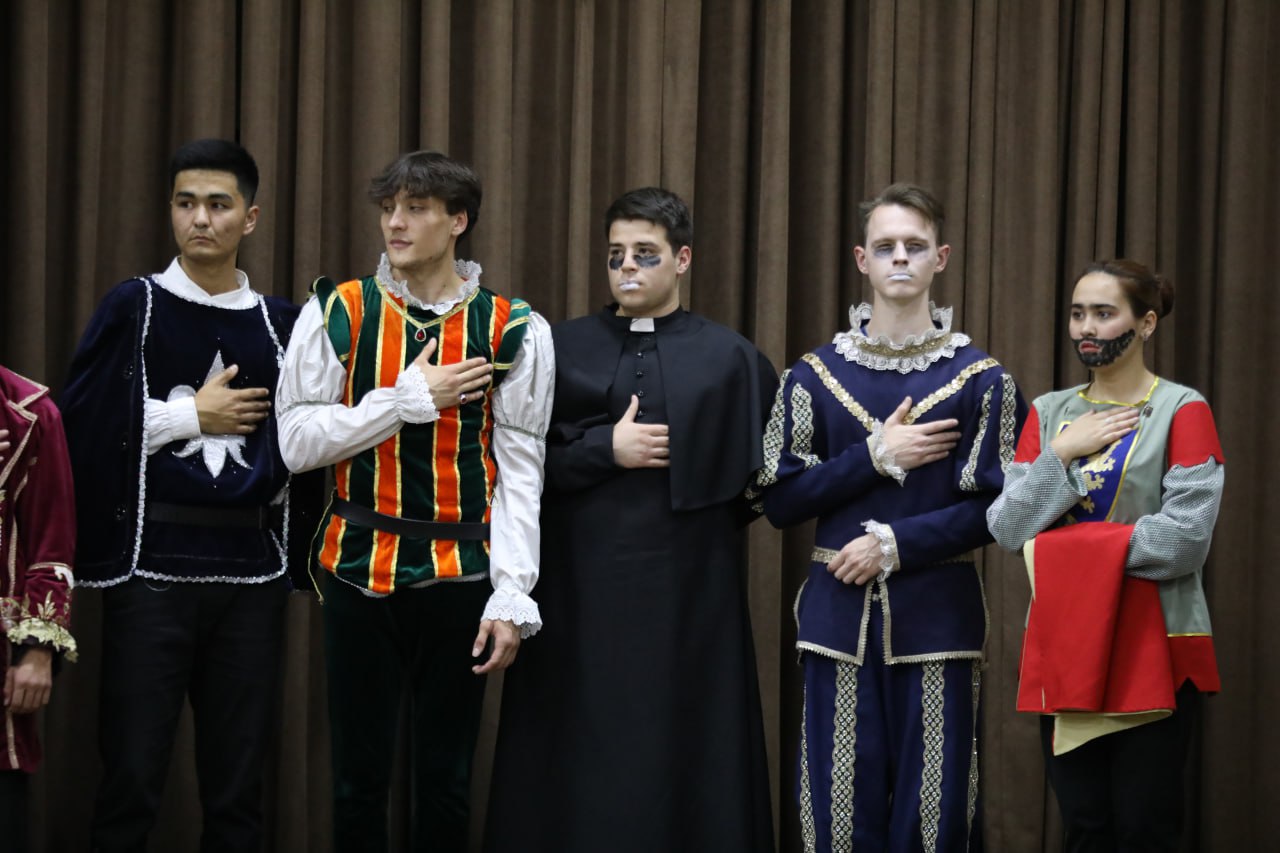
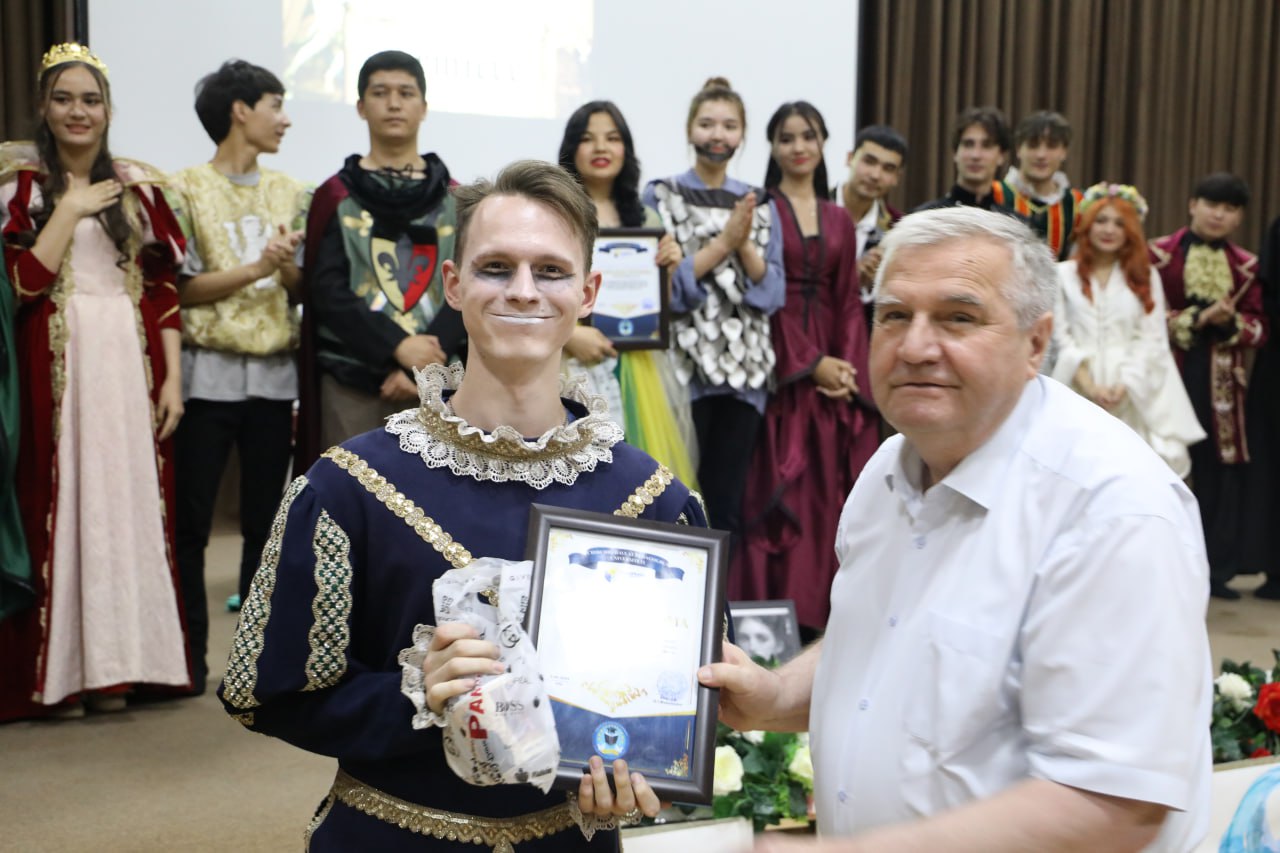
A performance and discussion of the stage play “Hamlet” was organized on the initiative of the Department of English Language Theory and Practice with the participation of international experts.

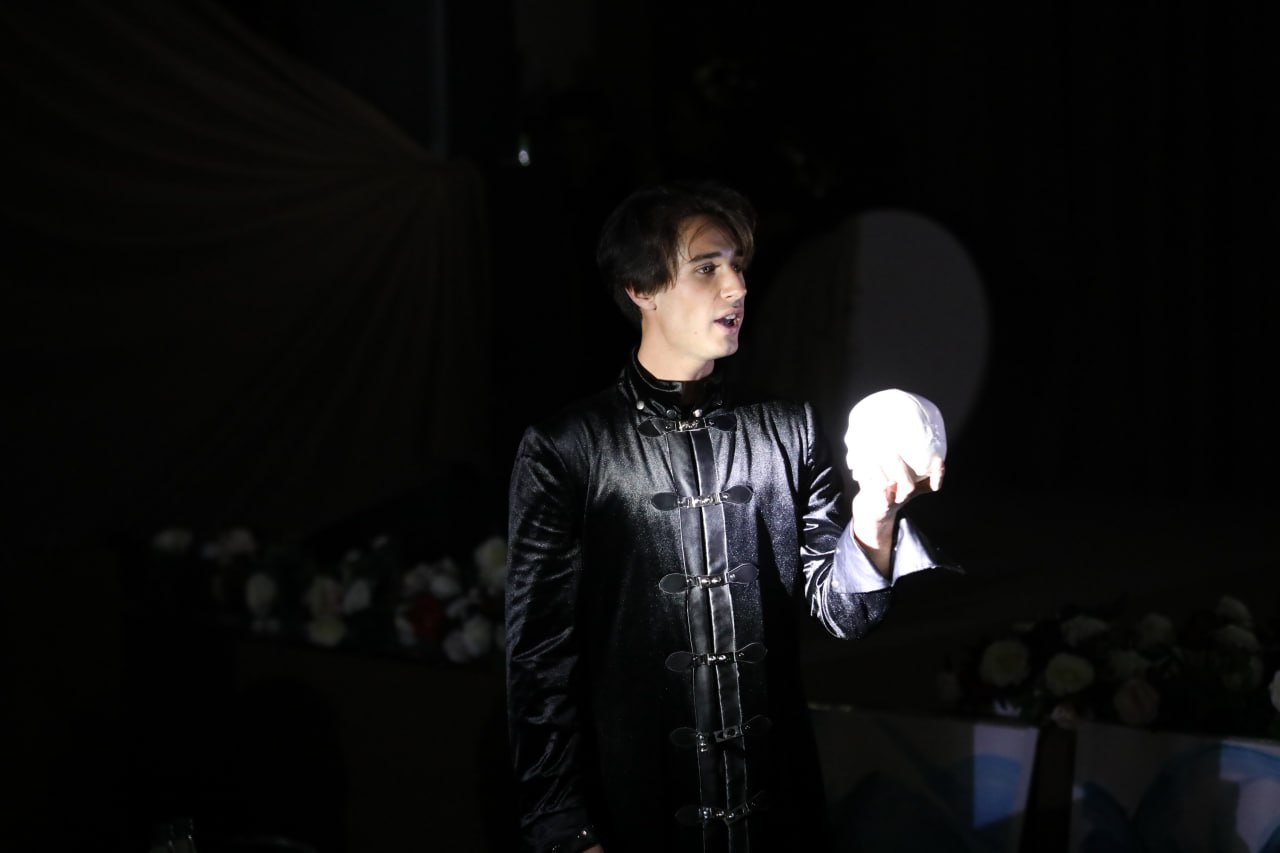
Today, a theatrical performance of “Hamlet” interpreted by university students was presented on the stage of CSPU. The work of the great playwright William Shakespeare was staged within the framework of the scientific and practical approach “Creative Teacher through the Eyes of a Student.”

The theatrical performance, which lasted 1 hour and 25 minutes, was presented in English. Recognized as one of the masterpieces of world drama, the play included more than 23 roles performed by 19 students. In particular, the role of Hamlet was performed by Abbos Memetov, Ophelia by Sevinch Mirzakhanova, Claudius by Janbolat Abduxaliqov, the Ghost by Georgiy Adayev, Gertrude by Gulasal Tojiquziyeva, and Laertes by Artur Massarov. More than 10 specialists, as well as teachers of the Department of English Language Theory and Practice, took part in staging the performance.

“At first, many people even forgot that the play was performed in English. I am impressed by the students’ acting skills and their deep understanding of English culture. Despite language barriers and geographical boundaries, through Shakespeare’s work and theatrical art I observed the students’ strong speaking abilities. I also felt that sincere and open intercultural dialogue is strengthening at your university,” said British expert Lucy Fenton.

The main goal of the performance was to develop students’ language competence, their ability for creative thinking in foreign languages, and to improve their speaking skills.
Hamlet performance photo 3


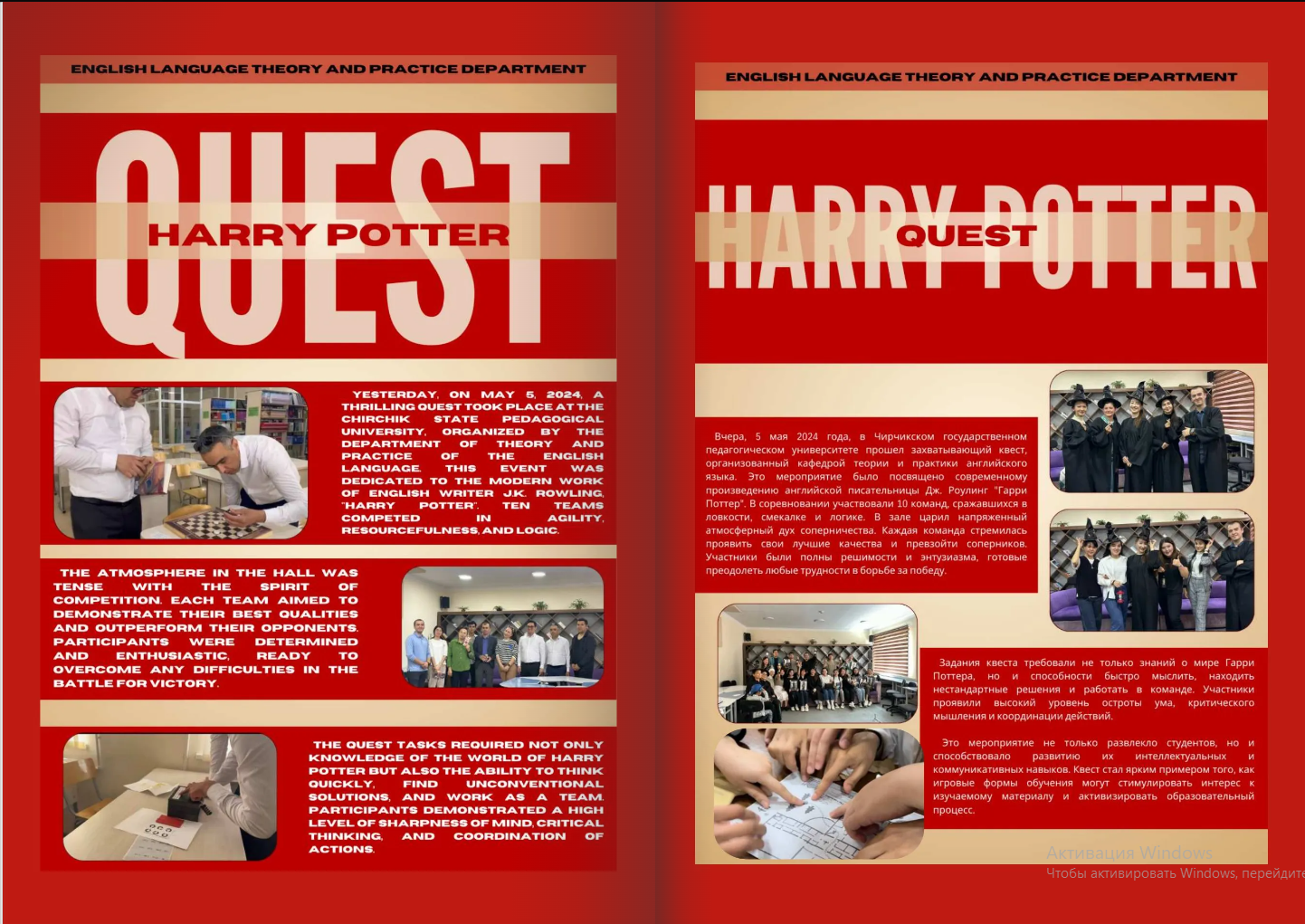
Harry Potter Quest event


Mission of the English Language Theory and Practice Department
Teaching English for Specific Purposes to teachers working in non-philological fields, using foreign experience in order to train qualified specialists.

The motto of the English Language Theory and Practice Department:

Latin proverb: SCIENTIA POTENTIA EST

The knowledge is power, знание - сила.

- Training specialized, highly qualified English language teachers in the field of English for Specific Purposes (ESP)
- Conducting seminars and training sessions in the field of journalism and increasing students’ interest in the press.
The main directions of the medium-term component of the long- and medium-term strategic plan of the English Language Theory and Practice Department:
- Enhancing English proficiency and exchanging experience through collaboration with teachers from non-philological faculties.
- Enhancing the effectiveness of an individual approach with teachers and students through the use of interactive and innovative teaching methods.

RATING dynamics over the years

16,78
39-place
23,12
20-place
2023-year
2024-year
2023-year
2024-yaer
International Scientific and Practical Conference

Integration of Philological and Pedagogical Research in an Innovative Educational Environment

The International Scientific and Practical Conference is dedicated to discussing current scientific approaches that reflect the transformation of modern education. The focus of the conference lies in the integration of philological and pedagogical research, the implementation of digital technologies, the development of innovative teaching methods, and the creation of flexible interdisciplinary models for training highly qualified specialists.

learn more →