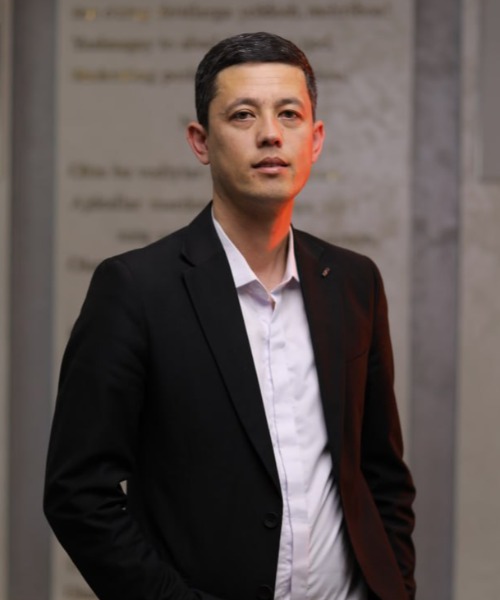
Bayzakov Jandos Abdazimovich
Associate Professor (acting head of the department)
(PhD)
f.f.f.d. (PhD),
PERSONAL INFORMATION SHEET
Baizakov Zhandos Abdazimovich
Since September 6, 2020:
Lecturer at the Department of Uzbek Linguistics, Faculty of Humanities, Chirchik State Pedagogical University.
Date of birth: Place of birth:
October 10, 1989 Bostanlyk District, Tashkent Region
Nationality: Party affiliation:
Kazakh None
Education: Graduated from:
Higher education 2020 (full-time)
Tashkent State University of Uzbek Language and Literature
Master’s program in Turkology (Researcher-Pedagogue)
Specialization according to education:
Teacher of Kazakh language and literature
Academic degree: Academic title:
None None
Foreign languages:
Russian
State awards (if any):
None
Deputy of the People’s Deputies Councils (republican, regional, city or district) or member of other elected bodies (full details required):
None
WORK EXPERIENCE
2012–2016 – Student of Tashkent State Pedagogical University
2016–2018 – Teacher of Kazakh Language and Literature,
Secondary School No. 1, Bostanlyk District, Tashkent Region
2018–2020 – Master’s student,
Tashkent State University of Uzbek Language and Literature named after Alisher Navoi,
Specialty: Turkology (Researcher-Pedagogue)
2020 – present – Lecturer at the Department of Uzbek Linguistics,
Faculty of Humanities, Chirchik State Pedagogical University
URGENCH STATE UNIVERSITY
SCIENTIFIC COUNCIL FOR AWARDING ACADEMIC DEGREES
PhD.03/30.12.2019.Fil.55.02
CHIRCHIK STATE PEDAGOGICAL UNIVERSITY
BAYZAKOV ZHANDOS ABDAZIMOVICH
POETOLOGICAL CONSTRUCTION IN MODERN UZBEK AND KAZAKH PROSE:
THE IDEAL OF THE CREATOR AND THE ARTISTRY OF IMAGES
10.00.06 – Comparative Literary Studies,
Comparative Linguistics and Translation Studies
ABSTRACT
of the Dissertation for the Degree of
Doctor of Philosophy (PhD) in Philological Sciences
Urgench – 2023
UDC: 821.512.133.09 (043.3)
Table of Contents
of the Abstract of the Dissertation for the Degree of
Doctor of Philosophy (PhD) in Philological Sciences
Bayzakov Zhandos Abdazimovich
Poetological construction in modern Uzbek and Kazakh prose:
the ideal of the creator and the artistry of images ................................. 5
Bayzakov Zhandos Abdazimovich
Poetic construction in modern Uzbek and Kazakh prose:
creative ideals and the art of imagery ................................................ 28
Bayzakov Zhandos Abdazimovich
Poetic construction in modern Uzbek and Kazakh prose:
creative ideals and image art ............................................................. 56
List of published works ................................................................. 60
URGENCH STATE UNIVERSITY
SCIENTIFIC COUNCIL FOR AWARDING ACADEMIC DEGREES
PhD.03/30.12.2019.Fil.55.02
CHIRCHIK STATE PEDAGOGICAL UNIVERSITY
BAYZAKOV ZHANDOS ABDAZIMOVICH
POETOLOGICAL CONSTRUCTION IN MODERN UZBEK AND KAZAKH PROSE:
THE IDEAL OF THE CREATOR AND THE ARTISTRY OF IMAGES
10.00.06 – Comparative Literary Studies,
Comparative Linguistics and Translation Studies
ABSTRACT
of the Dissertation for the Degree of
Doctor of Philosophy (PhD) in Philological Sciences
Urgench – 2023
The topic of the Doctor of Philosophy (PhD) dissertation was registered with the Higher Attestation Commission under the Cabinet of Ministers of the Republic of Uzbekistan under registration number B2022.2.PhD/Fil2528.
The dissertation was completed at Chirchik State Pedagogical University.
The abstract of the dissertation is published in three languages (Uzbek, Russian, and English – summary) on the website of the Scientific Council (www.fil-ik.urdu.uz) and on the ZiyoNet Information and Educational Portal (www.ziyonet.uz).
Scientific Supervisor:
Botirova Shakhlo Isamiddinovna
Doctor of Pedagogical Sciences, Associate Professor
Official Opponents:
Allambergenov Kengesbay
Doctor of Philological Sciences, Professor
Jumabayeva Jamila Sharipovna
Doctor of Philological Sciences, Professor
Leading Organization:
Karakalpak State University
The defense of the dissertation will take place at the meeting of the Scientific Council PhD.03/30.12.2019.Fil.55.02 under Urgench State University on “___” __________ 2023 at ___ o’clock.
(Address: 14 H. Olimjon Street, Urgench city, 220100.
Tel: (+99862) 224-67-00; Fax: (+99862) 224-67-00;
E-mail: www.fil-ik.urdu.uz)
The dissertation can be consulted at the Information and Resource Center of Urgench State University (registered under No. ___).
(Address: 14 H. Olimjon Street, Urgench city, 220100.
Tel: (+99862) 224-67-00)
The abstract of the dissertation was distributed on “__” ________ 2023.
(Registered in the protocol of the register No. ___ dated “___” __________ 2023).
BAYZAKOV ZHANDOS ABDAZIMOVICH
POETOLOGICAL STRUCTURE
IN MODERN UZBEK AND KAZAKH PROSE
(Monograph)
Chirchik – 2025
MINISTRY OF PRESCHOOL AND SCHOOL EDUCATION
OF THE REPUBLIC OF UZBEKISTAN
CHIRCHIK STATE PEDAGOGICAL UNIVERSITY
BAYZAKOV ZHANDOS ABDAZIMOVICH
POETOLOGICAL STRUCTURE
IN MODERN UZBEK AND KAZAKH PROSE
(Monograph)
Chirchik – 2025
J.A. Bayzakov
Poetological Structure in Modern Uzbek and Kazakh Prose (Monograph)
Reviewers:
T. Turtkulbayeva – Associate Professor (PhD),
Department of Kazakh Language and Literature,
Ajiniyaz Nukus State Pedagogical Institute
U. A. Bayqobilov – Associate Professor,
Department of Uzbek Language and Literature,
Chirchik State Pedagogical University
INTRODUCTION
The literary process of the 20th–21st centuries is significant as a period in which the artistic thinking of Turkic peoples rose to a new stage. In particular, the genre-related, compositional, and poetic transformations that took place in Uzbek and Kazakh prose have been shaped under the strong influence of the spirit of the time, socio-political changes, and national-cultural harmony. The shared history, ancient traditions, common sources of oral folklore, and traditions of cultural tolerance that unite the literatures of these two peoples have also given rise to similar tendencies in their prose thinking.
The years of independence marked a period of renewal for literature, during which new facets of realistic representation, the introduction of modern and postmodern principles, and the strengthening of mythopoetic constructions were observed in artistic exploration. In Uzbek and Kazakh prose, issues of human psychology, the philosophy of existence, national destiny, and historical memory were interpreted in harmony with epic reality. At the same time, genre diffusion, the process of essayization, and the formation of elements of new realism created profound transformations in the poetics of both literatures, enriching the internal logic of literary thinking.
The comparative literature method plays an important role in the study of Uzbek–Kazakh literary relations. As V. M. Zhirmunsky noted, typological similarities, without denying direct influence, serve to comprehend the universal laws of literary development. Through this method, aspects such as plot construction, image systems, poetic details, reinterpretation of mythological layers, aesthetic ideals, and principles of depicting human nature in the prose of both peoples are examined.
While a number of ideological stereotypes dominated prose during the period of socialist realism in the mid-20th century, the creative environment of the post-independence era opened the way for artistic freedom of thought. The new aesthetic consciousness laid the groundwork for a deeper exploration of national spirituality, historical memory, and the inner world of the individual. This process was reflected in the image-creating techniques of Uzbek and Kazakh writers, the activation of poetic language, and the expanded use of the aesthetic potential of the word.
Mythopoetics, existential interpretation, modern aesthetics, national spirit, and the awakening of historical philosophy constitute the core issues of this study. Investigating a literary work as an integrated system, revealing its vertical and horizontal relationships, and comprehending the fundamental essence of poetic interpretation are among the most pressing tasks of contemporary literary studies.
From this perspective, the main objective of the present research is to identify the factors that ensure the integrity of poetic interpretation in Uzbek and Kazakh prose, to examine the typological similarities and differences of creative concepts, to theoretically explain genre and compositional transformations, and to reveal the artistic representation of the relationship between time and the individual.
RECOMMENDED MASTER’S THESIS TOPICS
by Doctor of Philosophy (PhD) in Philology
JANDOS BAYZAKOV
CHIRCHIK STATE PEDAGOGICAL UNIVERSITY
Faculty of Humanities
Department of Uzbek Linguistics
MASTER’S THESIS TOPIC 1
METHODS OF TEACHING THE WORKS OF ABAY KUNANBAYULY AT SCHOOL
ANNOTATION
This study examines methodological issues in teaching the works of Abay Kunanbayuly within the school curriculum. Abay’s poems, prose reflections (Words of Edification), and philosophical thoughts are considered effective tools for developing students’ thinking skills as well as their linguistic and literary competence. The research analyzes lesson planning, methods of literary analysis, interpretative approaches, and elements of dialogic teaching. In addition, the role of Abay’s works in fostering students’ interest in literature and shaping their spiritual and moral values is highlighted. The study aims to define the theoretical and practical foundations of teaching Abay’s works in secondary school Kazakh literature classes.
MASTER’S THESIS TOPIC 2
METHODS OF TEACHING MUKHTAR AUEZOV’S SHORT STORIES THROUGH LITERARY ANALYSIS
ANNOTATION
This research explores effective ways of applying literary analysis methods in teaching Mukhtar Auezov’s short stories at school. The ideological and thematic content, artistic features, system of national values, and educational significance of the writer’s stories are analyzed, and teaching objectives are defined. Both traditional and innovative methods of literary analysis—problem-based analysis, psychological character analysis, compositional analysis, discussions, debates, creative tasks, and interactive techniques—are proposed. The study demonstrates that systematic use of literary analysis enhances students’ moral education and literary competence.
MASTER’S THESIS TOPIC 3
APPLYING CRITICAL THINKING TECHNOLOGIES IN TEACHING KAZAKH POETRY
ANNOTATION
This study examines the importance and effectiveness of using critical thinking technologies in teaching Kazakh poetry at school. Methods such as brainstorming, Venn diagrams, INSERT, cinquain poems, and T-charts are analyzed for developing skills of comprehension, analysis, and evaluation of poetic texts. Methodological recommendations are offered to enhance students’ independent thinking, argumentation skills, deep textual analysis, and creativity. The research proves that systematic application of critical thinking strategies increases students’ interest in literature and improves their conscious perception of poetry.
MASTER’S THESIS TOPIC 4
EFFECTIVENESS OF TEACHING EPIC POEMS THROUGH INTERACTIVE METHODS
ANNOTATION
This research investigates the effectiveness of interactive teaching methods in teaching Kazakh epic poems at school. Strategies such as dialogic teaching, group work, role-playing, debates, INSERT, Aquarium, Jigsaw, clustering, and digital platforms are analyzed. The study highlights methods for developing students’ comprehension, historical awareness, comparative analysis skills, argumentation, and creativity. The findings confirm that interactive methods foster interest in the subject, strengthen national identity, develop communication culture, and enhance critical thinking.
MASTER’S THESIS TOPIC 5
POSSIBILITIES OF PROJECT-BASED LEARNING IN TEACHING KAZAKH LITERATURE
ANNOTATION
This study explores the possibilities and effectiveness of project-based learning in teaching Kazakh literature. The theoretical foundations of project-based learning, its classroom implementation, and its role in promoting active learning are discussed. The research shows how project tasks develop students’ creativity, independent inquiry, research culture, teamwork skills, and ability to express and justify opinions. The study concludes that systematic use of project-based learning significantly improves the quality of literature education.
MASTER’S THESIS TOPIC 6
TEACHING MAGZHAN ZHUMABAYEV’S POETRY THROUGH CREATIVE TASKS
ANNOTATION
This research focuses on teaching Magzhan Zhumabayev’s poetry through creative tasks in secondary schools. Effective methods for conveying national spirit, emotional depth, and artistic features of the poet’s works are proposed. The importance of creative activities in developing students’ imagination, aesthetic taste, and speech culture is emphasized. The study aims to form active, thoughtful, and emotionally responsive learners.
MASTER’S THESIS TOPIC 7
TEACHING CONTEMPORARY KAZAKH PROSE USING INFORMATION AND COMMUNICATION TECHNOLOGIES (ICT)
ANNOTATION
This study examines teaching contemporary Kazakh prose through information and communication technologies. The use of digital resources, multimedia materials, electronic platforms, and interactive methods is analyzed to enhance students’ comprehension and analytical skills. The role of online tasks, presentations, video materials, virtual analysis, digital tests, and project work is highlighted. The research aims to modernize the teaching process, increase student engagement, develop critical thinking, and strengthen digital competence.
MASTER’S THESIS TOPIC 8
METHODS OF WORKING WITH LITERARY TEXTS IN THE ANALYSIS OF FICTIONAL WORKS
ANNOTATION
This study explores methodologies for working with literary texts during the analysis of fiction. It focuses on deep comprehension of literary works, including ideological-aesthetic, compositional, and linguistic features. Methods of reading, analysis, interpretation, character analysis, identifying authorial stance, and understanding figurative language are systematized. The study demonstrates that text-based analysis develops students’ critical thinking, language proficiency, and aesthetic perception.
MASTER’S THESIS TOPIC 9
METHODS BASED ON NATIONAL VALUES IN TEACHING FOLKLORE WORKS
ANNOTATION
This research examines theoretical and methodological aspects of teaching folklore works using approaches grounded in national values. Folklore is considered a key means of transmitting spiritual heritage, worldview, traditions, and customs. The pedagogical significance of folklore, educational potential of folklore genres, and methods of applying oral literature in the classroom are analyzed. The study highlights the role of folklore in developing national consciousness, language skills, and thinking abilities.
MASTER’S THESIS TOPIC 10
METHODS OF DEVELOPING STUDENTS’ LINGUISTIC COMPETENCE IN LITERATURE CLASSES
ANNOTATION
This study investigates the theoretical and practical foundations of developing students’ linguistic competence in literature lessons. Literature classes are viewed as an effective means of improving speaking, listening, reading, and writing skills. The research analyzes innovative teaching methods, dialogic learning, and critical thinking technologies, emphasizing their role in enriching vocabulary and enhancing communicative competence through literary texts.
DOCTOR OF PHILOSOPHY (PhD) DISSERTATION TOPICS
1. Temporal Poetics and Chronotope in Kazakh Prose
Abstract:
This study investigates the role of temporal poetics and the concept of chronotope in Kazakh prose. Temporal poetics reveals characters’ lives and the development of creative events through artistic depiction, while the chronotope allows for the analysis of the unity of time and space and the organization of events in the literary text. The article analyzes the development of Kazakh prose, traditional plot structures, authors’ methods of depicting time, and the features of chronotopes in historical and social contexts. The study aims to clarify the interconnection between time and space in Kazakh prose and their role in shaping plot and character images.
References:
Akhmetova, G. Theoretical Foundations of Kazakh Literature. Almaty: Kazakh University, 2015.
Zholdasbekov, B. Kazakh Prose: Structure and Style. Almaty: Atamura, 2018.
Smagulov, T. Poetics in the Kazakh Literary Language. Astana, 2017.
Bakhtin, M. Problems of Dostoevsky’s Poetics. Moscow: Iskusstvo, 1975.
Lotman, Y. Structure of the Artistic Text. Moscow: Iskusstvo, 1970.
Eikhenbaum, B. Poetics of Time and Space. St. Petersburg, 2001.
Karataev, S. Temporal Poetics in Kazakh Prose. Almaty: Kazakh University, 2016.
Zhumabayev, A. Chronotopic Analysis: Experience in Kazakh Literature. Shymkent, 2019.
Nurmukhanbet, D. Space and Time in Kazakh Prose. Astana: Gylym, 2020.
2. The Phenomenon of the Intellectual Novel in Kazakh Literature
Abstract:
This study explores the phenomenon of the intellectual novel in Kazakh literature. Intellectual novels are works that provoke readers to reflect on philosophical, social, and cultural issues. The article analyzes the distinctive features of intellectual novels in Kazakh prose, the psychological and philosophical aspects of character images, plot structure, and artistic expression of authorial ideas. It also examines the influence of social and historical context on the development of intellectual novels and their traditional and contemporary characteristics. The research aims to clarify the significance of the intellectual novel in literary and cultural studies.
References:
Akhmetova, G. Theoretical Foundations of Kazakh Literature. Almaty: Kazakh University, 2015.
Zholdasbekov, B. Kazakh Prose: Structure and Style. Almaty: Atamura, 2018.
Smagulov, T. Poetics in the Kazakh Literary Language. Astana: Zhazushy, 2017.
Karataev, S. Philosophical Novel in Kazakh Prose. Almaty: Kazakh University, 2016.
Zhumabayev, A. Features of the Intellectual Novel in Kazakh Literature. Shymkent, 2019.
Nurmukhanbet, D. Philosophical Character Images in Kazakh Prose. Astana: Gylym, 2020.
3. Text and Metatext in Kazakh Poetry
Abstract:
This article studies the relationship between text and metatext in Kazakh poetry. Text represents the literal content and linguistic structure of a poem, while metatext conveys hidden meanings, authorial intention, and contextually embedded significance. The study examines the interplay of text and metatext in traditional and contemporary Kazakh poetry, their artistic and ideological functions, the role of metatext in transmitting style and philosophical/cultural ideas, and its effect on reader interpretation. The research aims to reveal the complex dialogue between text and metatext and their artistic unity and interaction.
References:
Akhmetova, G. Theoretical Foundations of Kazakh Literature. Almaty: Kazakh University, 2015.
Zholdasbekov, B. Kazakh Poetry: Structure and Style. Almaty: Atamura, 2018.
Smagulov, T. Poetics in the Kazakh Literary Language. Astana: Zhazushy, 2017.
Karataev, S. Meaning and Style in Kazakh Poetry. Almaty: Kazakh University, 2016.
Zhumabayev, A. Text and Metatext: Kazakh Literary Experience. Shymkent, 2019.
Nurmukhanbet, D. Authorial Intent and Hidden Meaning in Kazakh Poetry. Astana: Gylym, 2020.
Akhmet, R. “Text and Metatext in Kazakh Poetry,” Kazakh Literature Journal, 2018.
Sabitova, G. “Artistic Function of Metatext,” Literary Studies, 2021.
Esimbek, B. “Dialogue of Text and Metatext in Kazakh Poetry,” Science and Education, 2022.
4. Ideology and Artistic Discourse in Kazakh Literature
Abstract:
This study examines the relationship between ideology and artistic discourse in Kazakh literature. Ideology is viewed as a socio-political and cultural factor shaping content, themes, and character images. Artistic discourse is the medium through which authors express ideas, social perspectives, and philosophical views using literary language and style. The study analyzes the interplay between ideological content and artistic methods in traditional and contemporary Kazakh literature, the effect on the reader, and the interaction between text and context. The research aims to clarify the unity of ideology and artistic discourse and their artistic, cultural, and social functions in Kazakh literature.
References:
Akhmetova, G. Theoretical Foundations of Kazakh Literature. Almaty: Kazakh University, 2015.
Zholdasbekov, B. Kazakh Prose and Poetry: Structure and Style. Almaty: Atamura, 2018.
Smagulov, T. Poetics in the Kazakh Literary Language. Astana: Zhazushy, 2017.
Karataev, S. Ideology and Artistic Style in Kazakh Literature. Almaty: Kazakh University, 2016.
Zhumabayev, A. Ideological and Artistic Relations in Kazakh Prose. Shymkent, 2019.
Nurmukhanbet, D. Text and Context in Kazakh Literature: Ideological Perspective. Astana: Gylym, 2020.
Akhmet, R. “Ideology and Artistic Discourse in Kazakh Literature,” Kazakh Literature Journal, 2018.
Sabitova, G. “Text and Ideology Connection,” Literary Studies, 2021.
Esimbek, B. “Role of Artistic Discourse in Kazakh Literature,” Science and Education, 2022.
1. Graduation Qualification Thesis Topic
THE TRANSFORMATION OF NATIONAL CODE AND ARTISTIC CONSCIOUSNESS IN KAZAKH LITERATURE
Abstract:
This study examines the scientific-theoretical aspects of the transformation of the national code and artistic consciousness in Kazakh literature. The concept of the national code is described as an important category that defines the historical memory, cultural identity, and spiritual values of the people. Kazakh literature serves as the main field for preserving the national code and renewing it within the artistic system. The study analyzes forms of the national code in literary texts, explores the essence and development of artistic consciousness, and examines the origins of national worldview in oral literature. The stages of formation of artistic consciousness in written literature are studied. The national idea in 19th-century literature is analyzed, and the role of the national code in the works of Alash period writers is clarified. Changes in artistic consciousness in Soviet-era literature are described, ideological influences on national content are revealed, and artistic transformations in the post-independence literary process are considered.
References:
Aymauytov Zh. Literary Issues. – Almaty: Gylym, 1996.
Baitursynuly A. Literary Guide. – Almaty: Atamura, 2003.
Baitursynuly A. Language Lessons. – Almaty: Ana tili, 1992.
Zhumabayev M. Pedagogy. – Almaty: Ana tili, 1992.
Kabdolov Z. Art of Words. – Almaty: Sanat, 2002.
Kaliev S. History of Kazakh Culture. – Almaty: Rauan, 1996.
Konyratbaev A. History of Kazakh Folklore. – Almaty: Ana tili, 1991.
Nurgaliyev R. Literary Theory. – Almaty: Kazakh University, 2004.
Nurgaliyev R. The Nature of Tragedy. – Almaty: Zhazyushy, 2001.
Omarova B. Trends in Contemporary Kazakh Literature. – Almaty: Kazakh University, 2012.
2. Graduation Qualification Thesis Topic
THE ISSUE OF HISTORICAL MEMORY IN KAZAKH PROSE DURING THE INDEPENDENCE PERIOD
Abstract:
This study analyzes the issue of historical memory in Kazakh prose of the independence period. Historical memory is an important category that preserves the people's past, cultural heritage, and national identity. Following independence, Kazakh prose began portraying national history from a renewed perspective. The study explores artistic representations of historical memory, the role of historical events and figures in shaping national consciousness, and the features of contemporary historical novels and stories. Literary texts convey lessons from the past to new generations, with historical memory serving as the basis for national identification. Prose works depict the hardships of the Kazakh people through artistic techniques, and authors reinterpret historical events to expand readers’ understanding. The balance of folk memory and factual materials is highlighted, while characters’ behaviors are linked to national values. The stylistic and genre characteristics of post-independence prose are described.
References: (same as previous)
3. Graduation Qualification Thesis Topic
THE MANIFESTATION OF MODERNISM AND POSTMODERNISM IN CONTEMPORARY KAZAKH LITERATURE
Abstract:
This study examines the manifestation of modernism and postmodernism in contemporary Kazakh literature. Modernism in literature is characterized by innovation, formal experimentation, and the introduction of new themes. Postmodernism is distinguished by multi-layered textual structures, intertextuality, and playfulness. The study analyzes manifestations of modernist tendencies in contemporary Kazakh prose and poetry. Postmodernist techniques aim to engage both the author’s consciousness and reader participation. Concepts of time and space are reinterpreted, experimental elements of artistic language offer new modes of perception, and psychological depth in characters is emphasized. Symbolic and mythological elements are prevalent in postmodernist works, and the dissolution of genre boundaries enhances interpretive possibilities. Stylistic innovations in contemporary Kazakh literature are directly influenced by modernist and postmodernist trends, while the combination of lyrical and epic directions allows creative freedom. Allusions and citations enrich the reader's cultural code, and historical events are reinterpreted in postmodernist prose. Modernist poetic language experiments align with national traditions, and the interplay of subjective and objective elements in artistic consciousness is explored.
References: (same as previous)
4. Graduation Qualification Thesis Topic
THE MYTHOPOETIC SYSTEM IN MUKHTAR AUEZOV’S WORKS
Abstract:
This study analyzes the mythopoetic system in Mukhtar Auezov’s works. A mythopoetic system refers to the harmonious integration of mythological, epic, and symbolic elements in literary texts. Auezov’s prose and dramaturgy play a key role in portraying national culture and historical consciousness. The study examines mythological motifs, epic plots, and mythopoetic depictions of characters in his works. The artistic interpretation of national traditions and folk legends is highlighted. The interplay of heroic epics and historical events is analyzed, showing how mythopoetic images convey popular consciousness and moral values. The relationship between epic tradition and authorial style is explored. Mythological elements influence character behavior, and artistic language and symbolism reflect national codes. The synthesis of history and myth is evident, and the combination of folkloric and mythological components in narrative structures is analyzed. Archetypal character images are identified, demonstrating continuity between authorial vision and traditional culture. National history and mythological consciousness are presented as an integrated whole in Auezov’s prose.
References: (same as previous)
5. Graduation Qualification Thesis Topic
INTERPRETING ABAY’S POETRY FROM A MODERN LITERARY-THEORETICAL PERSPECTIVE
Abstract:
This study interprets Abay Kunanbayev’s poetry from a contemporary literary-theoretical perspective. Abay’s poetry represents a unique phenomenon in Kazakh literature, integrating philosophical thought, moral ideas, and aesthetic taste. The study applies modern critical approaches to analyze Abay’s works, examining symbolic, metaphorical, and allegorical elements. Connections between philosophical thought and the national code are explored. Contemporary literary theories are used to analyze moral and ethical issues in his works. Linguistic and compositional features of lyrical poems are studied, revealing the harmony between aesthetic and ethical ideas. The interplay of folkloric and artistic elements is examined. Interpreting Abay’s poetry enriches readers’ historical, cultural, and philosophical awareness. Authorial style, poetic rhythm, and structural organization are analyzed, as well as the influence of his works on contemporary Kazakh literature. Critical thinking methods are employed to explore ideological and aesthetic levels, with a modern assessment of Abay’s philosophical ideas and interpretive possibilities of poetic language. The interrelation between textual structure and cultural context is revealed.
References: (same as previous)
RESUME
Full Name: Zhandos Abdazimovich Baizakov
Date of Birth: October 10, 1989
Place of Birth: Bostandyk District, Tashkent Region, Republic of Uzbekistan
Contact Information:
Phone: +998 99 859 62 55
E-mail: jandozbayzakov@gmail.com / jandosbajzakov906@gmail.com
Objective
To continue professional research and teaching activities in the field of philology and literary studies, contributing to the development of higher education and science.
Education
2012–2016 – Tashkent State Pedagogical University
Bachelor’s Degree: Philology (Kazakh Language and Literature)
2018–2020 – Tashkent State University of Uzbek Language and Literature
Master’s Degree: Philology (Turkology)
Academic Degree
Doctor of Philosophy (PhD) in Philology
PhD Thesis:
10.00.06 Poetic Constructions in Contemporary Uzbek and Kazakh Prose: The Ideal of the Creative Personality and the Aesthetic Representation of Characters
10.00.06 Замонавий ўзбек ва қазоқ насрида поэтологик конструкция: ижодкор идеали ва образлар бадиияти
Work Experience
2020 – Present – Shyrshyk State Pedagogical University
Faculty of Humanities, Department of Uzbek Linguistics
Position: Researcher and Lecturer
Teaching Uzbek language and literature
Conducting scientific research
Developing curricula and teaching materials
2016–2020 – Secondary School No.1, Bostandyk District
Position: Teacher
Teaching Kazakh language and literature
Preparing educational and methodological materials
Conducting creative and scientific work with students
Professional Skills
Scientific-theoretical analysis of literary texts
Methods of teaching literature
Conducting research and academic writing
Preparing curricula and methodological tools
Working with ICT tools
Languages
Kazakh – Native
Uzbek – Fluent
Russian – Good
English – Basic
Scientific Research Projects
Scientific articles published in international journals
(indexed in Web of Science, Scopus, and other internationally recognized databases)
Baizakov Zh. “National Language – the Foundation of the Nation: Reflections on the Present and Future of the Kazakh Language”, Ekonomika i Sotsium, No. 5(132), 2025.
Scientific articles published in national journals
Baizakov Zh. “The Issue of Personality in Abai’s Teachings”, Til va Adabiyot.uz, Scientific-Methodological Electronic Journal, Tashkent, No. 11, 2025, pp. 122-123.
Participation in international and national conferences
Baizakov Zh.A. “The Poetic World of Abai: The Influence of Abai’s Spiritual Heritage on the Turkic World”, International Scientific-Theoretical Conference, Nukus, April 4, 2025, pp. 269-273.
Baizakov Zh. “The Art of the Novel and the Genesis of Genres”, International Scientific-Theoretical Conference on “Current Issues, Solutions, and Prospects in Philological Education in the New Uzbekistan”, October 17, 2025, pp. 1102-1106.