
Feruza Ilmuradova
Ilmurodova Feruza Shakirovna is a history teacher specializing in history education and the methodological preparation of future teachers in Uzbekistan
Ilmurodova Feruza Shakirovna is a history teacher specializing in history education and the methodological preparation of future teachers in Uzbekistan

Educational Methodology and Expertise
Ilmurodova Feruza Shakirovna, a graduate of Chirchik State Pedagogical University, was born on January 30, 1982 in the city of Samarkand, Samarkand region of the Republic of Uzbekistan. Department of Social Sciences, Faculty of Humanities, Chernivtsi State Pedagogical University.
In 2000-2004, Nizomiy Nomi graduated from the History Department of Tashkent State Pedagogical University (Bachelor's degree), and in 2004-2006, Nizomiy Nomi graduated from Tashkent State Pedagogical University (Master's degree).
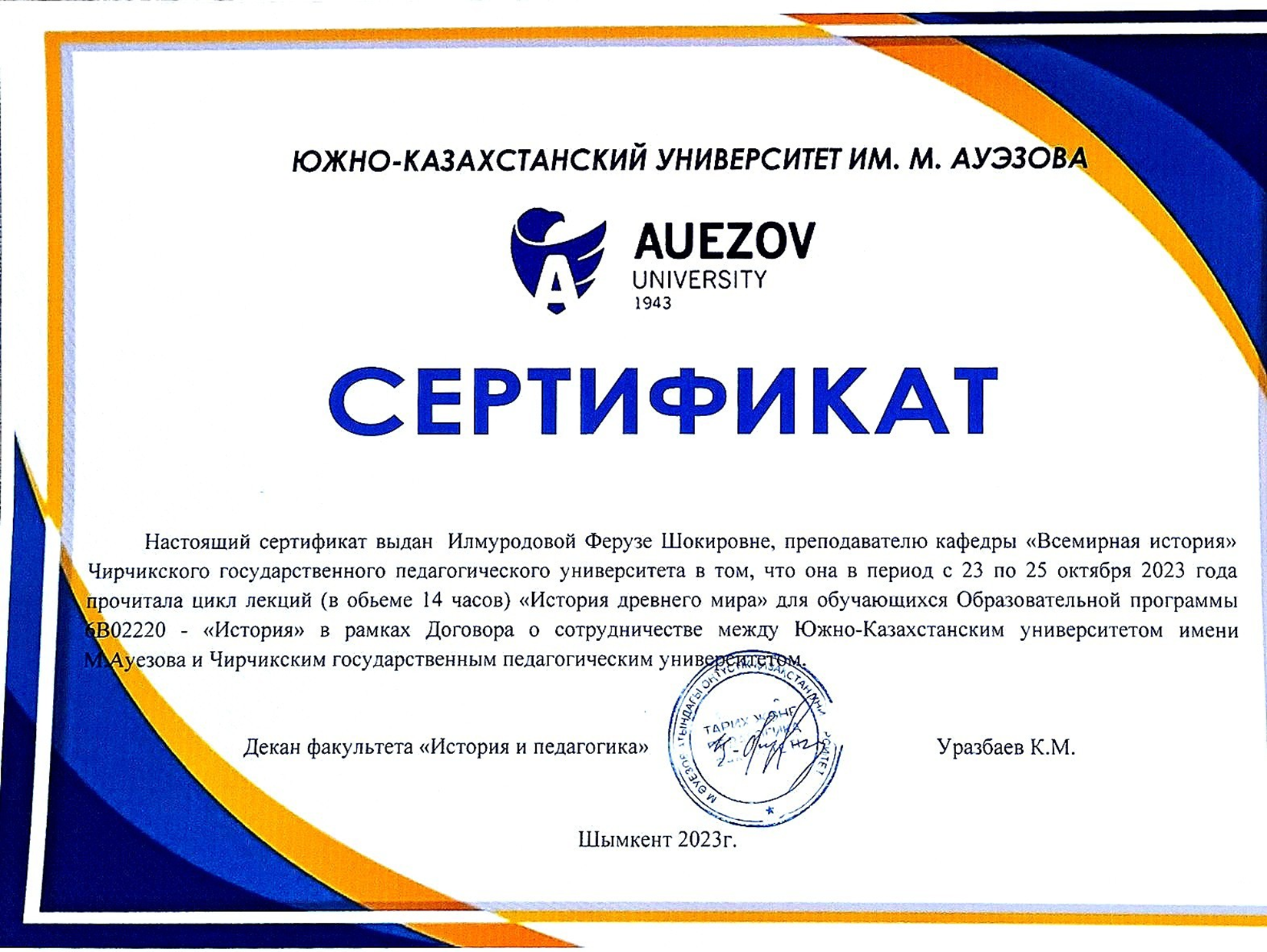
2006 - 2015 Tashkent Geodetic and Cartographic College history of Fani ukituvchisi, 2015-2017. Mirzo Ulugbek tumani 275th mektabda MMIB Director, 2017-2022. Mirzo Ulugbek tumani 275th mektabda Tarikh Fani ukituvchisi, 2022-2023. 2022-2023. Department of History and Teaching Methods Faculty of Humanities Chirchik State Pedagogical University, Since 2024, the Department of Social Sciences of the Faculty of Humanities of Chirchik State Pedagogical University will operate on the basis of the Department of Historical Sciences.
More than 40 scientific papers have been published on the topic of the dissertation, including 10 scientific articles in national and 5 foreign journals submitted for the degree of Doctor of Historical Sciences by the Higher Attestation Commission of the Republic of Uzbekistan.
The research results have been presented at 10 international conferences, 5 international and 5 international conferences.
All necessary documents for the degree of Candidate of Sciences, copies of diplomas, personal data, confirmation of the thesis topic, copies of the UAC bulletin, documents for the degree of Doctor of Philosophy exotic animals.
Received the degree of Doctor of Philosophy in the specialty 13.00.02 – theory and methodology of teaching and upbringing:
Foreign language (English): 62 points
Expertise: 78 points.
Honorary degrees are awarded by the President of the Republic of Uzbekistan in accordance with the Law of the Republic of Uzbekistan "On State Awards of the Republic of Uzbekistan". Scientific degrees are awarded to scientists who have completed an internship at the scientific seminar at the Institute of Oriental Studies of the Russian Academy of Sciences, in which the scientific seminar accepts dissertations for the degree of Doctor of Historical Sciences, as well as for the degree of Doctor of Historical Sciences. 3 nafar farandi bor.
Islamic philosophy has played a pivotal role in shaping the intellectual and scientific heritage of world civilization. Its criteria for scientific activity extend beyond mere empirical verification, encompassing spiritual, moral, and ethical dimensions. From a phenomenological perspective, knowledge in Islamic thought emerges as a dynamic interaction between human consciousness and divine revelation, reflecting an integrated approach to understanding reality. This perspective emphasizes that scientific inquiry in the Islamic tradition is inseparable from ethical responsibility and spiritual awareness, providing a holistic framework for intellectual development.
Historically, Islamic philosophers and scholars synthesized Greek, Indian, and Persian philosophical traditions, creating a unique epistemological system that combined rational inquiry with metaphysical and ethical reflection. This synthesis facilitated the advancement of natural sciences, mathematics, medicine, and social sciences in the medieval Islamic world, while simultaneously shaping a distinct intellectual culture that valued moral and spiritual insight alongside empirical investigation. The integration of diverse philosophical legacies enabled Islamic thought to serve as a bridge between ancient traditions and the emerging modern intellectual frameworks.
The present study aims to examine the cognitive, ethical, and methodological foundations of scientific knowledge in Islamic philosophy, employing a comparative-historical and phenomenological approach. By analyzing the interplay between reason, morality, and spiritual consciousness, this research seeks to provide a nuanced understanding of the mechanisms through which Islamic intellectual culture contributed to the global history of science and thought, highlighting its enduring relevance for contemporary philosophical and scientific discourse.
My scientific and strategic goal is to create an effective educational model and methodological system that serves to prepare future history teachers as a competitive professional, methodical and digital competencies, with a developed critical and historical thinking, loyal to national and universal values, based on national educational policy, international educational standards and modern pedagogical innovations, to introduce it into practice.