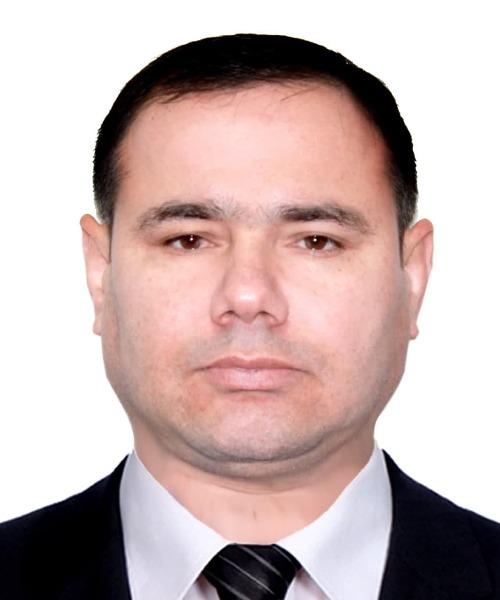
Fayziyev Vokhid Bakhromovich was born on December 10, 1980, in Dehqonobod district, Kashkadarya region, Uzbekistan. He earned his Bachelor’s degree from Karshi State University in 2003 and his Master’s degree from Tashkent State Pedagogical University named after Nizami in 2005. Between 2003 and 2009, he pursued research at the National University of Uzbekistan named after Mirzo Ulugbek in preparation for his PhD dissertation, which he successfully defended in 2011. In 2020, Professor Fayziyev defended his doctoral dissertation at the Specialized Council of the Institute of Microbiology, Academy of Sciences of the Republic of Uzbekistan, and was awarded the academic degree of Doctor of Biological Sciences. Currently, he serves as Head of Department and continues his active research and academic work in the field of biology.
"No matter how much you study and how knowledgeable you become, if you do not act upon it, you remain ignorant…!"
Acquiring knowledge and devoting it to the benefit of the people, as well as to the education and upbringing of future generations, is an honor for every individual, and particularly for intellectuals. It is also a noble contribution to ensuring that the land which once nurtured great scholars will continue to give rise to outstanding personalities.
Fayziyev Vokhid Bakhromovich is married and the father of three children.
Vokhid Bakhromovich Fayziyev initially conducted scientific research on the distribution, biology, and diagnostics of potato-infecting viruses – X, Y, A, S, L, and M – under the climatic conditions of Uzbekistan. He developed specific antisera for the diagnosis of these viruses and successfully applied them in immunodiagnostics.
In his subsequent research, he isolated the Potato virus X (PVX) prevalent in Uzbekistan, studied its biological and molecular-genetic characteristics, and laid the foundation for a new scientific direction in the country dedicated to the study of the molecular biology of viruses.
The results of his research have been effectively applied in virology, agriculture, plant protection, and quarantine sectors of Uzbekistan.
In Science: Studying and identifying the molecular-genetic characteristics of plant viruses distributed in Uzbekistan.
In Agriculture: Assessing the resistance of potato varieties and samples to plant viruses.
In Plant Protection and Quarantine: Identifying natural reservoir plants of viruses and applying findings to plant protection strategies.
In Higher Education: Introducing modern research methods into laboratory practices.
In Plant Breeding: Developing virus-resistant cultivars.
Furthermore, based on his research, the genomic nucleotide sequences of more than ten phytopathogenic viruses have been sequenced and deposited in the NCBI (National Center for Biotechnology Information) database on behalf of Uzbekistan, thereby contributing to the enrichment of this global scientific repository.
In addition, throughout his career, Prof. V. Fayziyev has conducted joint scientific research in collaboration with a number of leading universities and research centers worldwide. Notably, he has worked with scholars from Moscow State University (Russia), Quaid-i-Azam University (Pakistan), and Al-Farabi Kazakh National University (Kazakhstan). At present, he continues to broaden and strengthen these international scientific partnerships.
Prof. Fayziyev is the author of 2 textbooks, more than 10 teaching manuals, and 3 monographs. He has published over 100 scientific articles in national and international journals, more than 10 of which are indexed in leading international databases such as Scopus and Web of Science. In addition, he holds 2 authorship certificates for his inventions and discoveries in the field of biology. Under his scientific supervision, to date, 8 PhD holders (Candidates of Sciences) have been successfully trained.
Prof. Fayziyev possesses extensive experience as an active, dedicated educator and an accomplished academic leader. His teaching and administrative career in higher education began at the National University of Uzbekistan named after Mirzo Ulugbek. Subsequently, his pedagogical and leadership activities have encompassed the following institutions:
· 2005–2006 – Served as a biology teacher at the College of Computer Technologies in Tashkent. During this period, he worked consistently with gifted students and contributed to the development of their academic abilities.
· 2006–2009 – Pursued postgraduate studies (aspirant) at the National University of Uzbekistan named after Mirzo Ulugbek, conducting research for his Candidate of Sciences dissertation.
· 2012–2015 – Worked as a lecturer at the Department of Microbiology and Biotechnology, National University of Uzbekistan named after Mirzo Ulugbek, while simultaneously holding the position of Deputy Dean for Spiritual and Educational Affairs. In this capacity, he actively promoted students’ intellectual and moral development as well as their social engagement.
2015–2017 – Served as Dean of the Faculty of Biology at the National University of Uzbekistan named after Mirzo Ulugbek. During his tenure, he contributed to increasing the effectiveness of research, educational, and spiritual-enlightenment activities within the faculty. He also played a key role in the establishment and re-establishment of several academic departments, including Microbiology, Biotechnology, Ecology, and Biophysics.
2017–2019 – Worked as an Associate Professor at the Department of Natural Sciences and simultaneously served as Head of the Extramural Studies Division at the Chirchik State Pedagogical Institute of Tashkent region. In addition to teaching microbiology and virology, he was actively engaged in organizing the extramural educational process and ensuring students had access to the necessary learning materials.
2019 – present – Founded the Department of Biology at Chirchik State Pedagogical Institute (now Chirchik State Pedagogical University) and has been serving as its Head. Under his leadership, the department has strengthened its research potential and improved the training of academic and pedagogical staff. He has enhanced the effectiveness of the educational process, promoted cultural and spiritual development within the department, and successfully integrated talented young scholars into the academic community. Moreover, he has expanded international cooperation by involving foreign professors and lecturers in the educational process. During this period, more than ten faculty members have defended their dissertations and received academic degrees, and they are currently contributing to the higher education system.
On his initiative, the Molecular Biology and Bioinformatics research laboratory was established within the department, which today serves as a center for scientific investigations carried out by doctoral candidates, master’s students, and talented undergraduates. Furthermore, he was instrumental in creating doctoral programs (basic doctoral studies) in the specializations 03.00.04 – Microbiology and Virology and 03.00.07 – Plant Physiology and Biochemistry under the Institute of Postgraduate Education. To date, eight doctoral candidates specializing in these fields have successfully defended their dissertations on time and earned the academic degree of Doctor of Philosophy (PhD) in Biological Sciences.
Thanks to the efforts of V.B. Fayzyev as the head of the department, its scientific potential has significantly improved. The number of young and talented academic staff has increased, while the provision of educational literature for students, the quality of teaching, and the effectiveness of scientific research have all been enhanced.
The complete list of publications by Voxid Baxramovich Fayziyev is not presented here; however, to date he is the author of three monographs and more than 100 scientific articles.
The full list of his works and direct references are not included in this document. Nevertheless, his publications can be partially accessed through academic databases and platforms such as Scopus, Web of Science, Google Scholar, and ResearchGate, or by searching within relevant scientific journals.
Below is a selection of his publications, authored individually or in collaboration with colleagues (identified through a preliminary search):
Sobirova ZS, Fayziev VB, Akhmadaliev BJ, Omonov NS, Sobirova KG, Akhmedova ZY, Egamberdiyeva L. (2024). MDMV influence on the productivity of maize (Zea mays L.). SABRAO J. Breed. Genet. 56(6): 2196-2204. http://doi.org/10.54910/sabrao2024.56.6.2.
Jovlieva, D., Fayziev, V., Vakhobov, A., ...Mirzaeva, Z., Nugmonova, K. (2024). Preparation of Polyclonal Antiserum for Potato X virus Journal of Wildlife and Biodiversity, 8(1), pp. 268–278 https://doi.org/10.5281/zenodo.10206960
Kanwal, K., Zafar, M., Ahmad, M., ... Majeed, S., Fayziev, V. (2024). Exploring the micromorphological diversity of palynomorphic flora from lesser Himalaya biodiversity hotspot.Notulae Botanicae Horti Agrobotanici Cluj-Napoca, 52(2), 13462
Kholmatova, M., Fayziev, V., Akhmadaliev, B., Absamatov, T., Temirov, A., Tangriev, T., Jovlieva, D., & Askarova, M. (2024). Molecular identification of potato leaf roll virus and its impact on important nutrients in tubers. Journal of Wildlife and Biodiversity, 8(3), 149–161. https://doi.org/10.5281/zenodo.11398192
Manzoor, M. et al. (2024). Assessment of Long-Term Climate Change Impact on Alpine Vegetation of Western Himalaya. In: Fahad, S., Saud, S., Nawaz, T., Gu, L., Ahmad, M., Zhou, R. (eds) Environment, Climate, Plant and Vegetation Growth. Springer, Cham. https://doi.org/10.1007/978-3-031-69417-2_18
Yusubakhmedov AA, Fayziev VB, Adilov B, Makhmudov TKH, Abduvaliev BA, Kurganov SK, Bekmatova EE, Temirov AA, Erdanaeva SHP, Atabaeva DT (2024). Molecular identification of the potato virus M isolate PVM-UZ-ay1 with coat protein (CP) gene and phylogenetic analysis. SABRAO J. Breed. Genet. 56(5): 1769-1777. http://doi.org/10.54910/sabrao2024.56.5.2.
Sattorov, M., Sheveleva, A., Fayziev, V., Chirkov, S. (2020). First Report of Plum Pox Virus on Plum in Uzbekistan. Plant Disease. 104(9), pp. 2533 https://doi.org/10.1094/PDIS-03-20-0456-PDN
Sobirova, Z.S., Fayziev, V.B., Abduraimova, K.I. (2020). Effect of the virus of the yellow dwarf corn mosaic growth and development of varieties of corn in various phases Journal of Advanced Research in Dynamical and Control Systems. 12(6 Special Issue), pp. 602–606 https://scholar.google.com/citations?view_op=view_citation&hl=ru&user=Dw6Qy40AAAAJ&citation_for_view=Dw6Qy40AAAAJ:3fE2CSJIrl8C
Fayziev, V., Jovlieva, D., Juraeva, U., Shavkiev, J., Eshboev, F. (2020). Effects of PVXN-UZ 915 necrotic isolate of Potato virus X on amount of pigments of Datura stramonium leaves. Journal of Critical Reviews. 7(9), pp. 400–403 https://www.researchgate.net/publication/341945469
Ramazonov, B.R., Mutalov, K.A., Fayziev, V.B., Koraev, S.B. (2020). Morphogenetic characteristics and biological activity of Takyr and meadow soils of the Republic of Karakalpakstan (On the example of soils of chimbay district) morphogenetic characteristics and biological activity of Takyr and Meadow soils of the Republic of Karakalpakstan (on the example of soils of Chimbay District)Journal of Critical Reviews, 7(5), pp. 243–249 http://dx.doi.org/10.31838/jcr.07.05.43